The Road to Healing
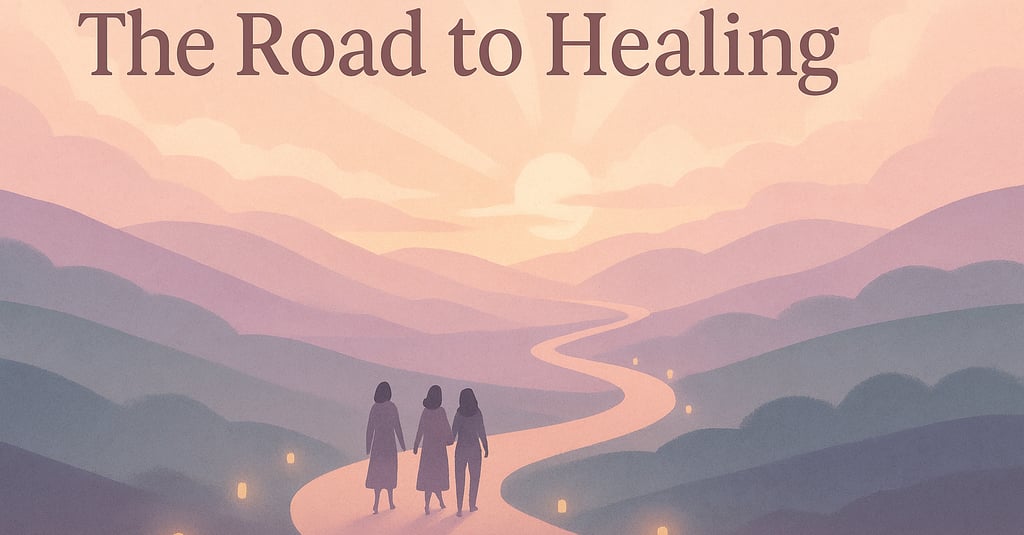
The Road to Healing is a raw and honest look at what it really takes to heal, from trauma, addiction, and generational patterns. This blog walks you through why every journey is unique, how faith and sisterhood can hold you up when you’re tired, and practical ways to start: setting boundaries, reaching out for help, finding tools that support your recovery, and learning to choose healing over hiding. It’s a compassionate reminder that no one can do the work for you, but you never have to walk this road alone.
12/7/20256 min read
There’s this thing we don’t always say out loud:
Healing is beautiful, yes,
but it can also be brutally hard, confusing, and lonely at times.
If you’ve ever wondered, “Why is this taking so long?” or “Why does it still hurt?” or “Why does everyone else seem to be doing better than me?” this is for you.
This is the road to healing: real, raw, holy, and deeply personal.
No Two Healing Journeys Look the Same
We love a good before-and-after story. One picture where everything is broken, and the next where everything is suddenly fixed. But real life doesn’t move in straight lines like that.
Your journey might include:
Trauma from childhood or relationships
Addiction or compulsive behaviors
Loss, grief, and heartbreak
Anxiety, depression, or feeling numb
Family dysfunction and generational patterns
Someone else’s journey might look nothing like yours, and that’s okay.
Healing is not a race. There is no trophy for “fastest to recover.” There is no gold star for pretending you’re okay.
Your pace, your process, your timeline are allowed to be different.
The moment you stop comparing your healing to someone else’s is the moment you free up energy to actually tend to your own heart.
The Real, Raw Truth About What It Takes to Heal
Healing is not just bubble baths and journaling. Sometimes it is:
Crying on the bathroom floor because you finally let yourself feel what happened.
Shaking as you set a boundary with someone who’s always crossed your lines.
Wanting to go back to the old coping mechanism because it feels easier than dealing with the pain.
Feeling lonely because the people who benefited from your silence don’t love your new voice.
Being exhausted from unlearning patterns you’ve lived in for decades.
Healing asks for honesty.
Healing asks for courage.
Healing asks for consistency when you’d rather disappear.
It doesn’t mean you never fall apart - it means you learn how to put yourself back together with more truth and more tenderness than before.
Trauma, Addiction, and the Layers We Carry
A lot of what we call “broken” is actually the way our mind and body learned to survive.
Trauma teaches you to scan for danger all the time.
Addiction offers relief when your nervous system is screaming.
People-pleasing keeps you “safe” when you’ve been punished for having needs.
So when you start to heal, you’re not just changing habits, you’re gently telling your mind and body:
“It’s okay. We don’t have to live like this anymore.”
That takes time.
That takes support.
That takes grace.
And if you struggle with addiction, bingeing, self-harm, or anything that feels bigger than you, it doesn’t mean you’re weak. It means your pain needed a place to go. Healing is learning new places for that pain to land.
Where Do I Even Begin?
If the road to healing feels huge and overwhelming, start small. Really small.
Here are a few first steps:
Name what hurts.
You don’t have to tell the whole world, but be honest with yourself:
What am I really struggling with? What keeps repeating? What am I afraid to say out loud?Choose one safe person.
A friend, a sister, a sponsor, a therapist, a pastor. Not everyone needs to know everything. Start with one person you trust and share one layer deeper than you usually do.Pay attention to patterns.
When do you feel most triggered? Who drains you? What situations send you back to coping in ways you don’t like? Awareness is the doorway to change.Take one gentle action.
Schedule a therapy appointment. Look up a local or online recovery meeting. Write down your feelings for ten minutes. Go for a walk instead of numbing out, just once.
You don’t have to fix your whole life today. Just take one honest step.
Faith: You Don’t Walk This Road Alone
Healing is hard, but you are not carrying it alone.
Faith doesn’t mean you never hurt. It doesn’t mean you never struggle. It means that even in the middle of the mess, you are held.
When you feel like you’re failing, God still calls you “Beloved.”
When you don’t know the next step, God knows the whole road.
When you’re tired of trying, God’s grace says, “We can start again.”
Faith on the road to healing might look like:
Whispered prayers, even if all you can say is, “Help.”
Reading one verse and holding onto it all day.
Trusting that even your slow progress counts as holy work.
You don’t have to have perfect faith to be loved. You don’t have to have perfect faith to heal. Sometimes faith is simply believing: “My story is not over yet.”
Sisterhood: Healing Is Heavy. Don’t Carry It Alone
There is a special kind of magic when women walk each other home.
Sisterhood in healing doesn’t mean everyone is perfect, fixed, or has all the answers. It means:
“You can say the hard thing, and I won’t run.”
“I see your struggle, and I still see your strength.”
“When you forget who you are, I’ll remind you.”
You might find this sisterhood:
In recovery meetings or support groups
In a small group at church
In online communities centered on faith, healing, and recovery
In one or two friends who are also doing their inner work
You don’t need a crowd. You just need a few women who are willing to be real, to listen, and to walk alongside you.
What to Focus on When You Begin Your Healing Journey
When you’re just getting started, it’s easy to get overwhelmed by all the things you “should” be doing. Instead, focus on these core pieces:
Safety.
Emotional and physical safety come first. If you’re in a dangerous situation, reaching out for help and creating a safety plan is step one.Honesty.
Healing doesn’t work on top of lies. Be honest with yourself, with God, and with at least one trusted person about what’s really going on.Support Team.
You were never meant to do this alone. Think of your healing support team: therapist, sponsor, mentor, pastor, close friend, recovery group.Boundaries.
Boundaries are not punishment; they’re protection. It’s okay to create distance from people and patterns that pull you back into harm.Compassion for Yourself.
You will have days where you slip, fall back into old patterns, or feel like you’re right back where you started. You’re not. You’re learning. Talk to yourself with the same kindness you’d offer a friend.
Where and How to Reach Out When You Need Help
Reaching out can feel terrifying, especially if you were taught to keep everything inside. But asking for help is not weakness; it’s wisdom.
Here are some places to start:
Therapist or Counselor
Look for someone who understands trauma, addiction, or whatever you’re facing. Many offer virtual sessions.Recovery Groups
Programs like AA, NA, Celebrate Recovery, and other support groups (both faith-based and secular) offer community with people who understand.Spiritual Support
A pastor, spiritual mentor, or faith-based counselor can help you process your journey through the lens of faith.Trusted Friend or Sister
Sometimes what you need most is someone to sit with you, hear you, and remind you that you’re not crazy and you’re not alone.
If you’re in deep distress or having thoughts of self-harm, please reach out to a crisis line in your country (in the U.S., you can call or text 988) or emergency services if you are in immediate danger. Your life is precious.
When you reach out, you don’t have to have the perfect words. You can simply say:
“I’m not okay and I don’t want to be alone.”
“I think I need help with some things I’m struggling with.”
“I’m scared of where my thoughts are going.”
That’s enough.
Tools You Can Use on the Road to Healing
You don’t need every tool at once; choose what fits your season:
Journaling
A safe place to pour out your thoughts, prayers, memories, and patterns you’re noticing.Breath work & Grounding
Simple breathing exercises, noticing five things you see/hear/feel, or putting your hand on your heart and reminding yourself, “I am safe in this moment.”Movement
Gentle walks, stretching, dancing in your living room, moving your body can help release stored stress and tension.Therapy & Support Groups
These give you understanding, skills, and community.Prayer & Meditation
Sitting quietly with God, listening, reading a verse slowly, repeating a short prayer throughout the day.Healthy Routines
Regular sleep, hydration, nourishing food, small daily rituals that signal to your body, “We’re safe. We’re cared for.”
Remember, tools are not about doing healing “perfectly” - they’re about giving yourself options besides going numb or going back.
No One Can Do It For You | But You Don’t Have to Do It Alone
This part can be both empowering and frustrating:
No one can walk your exact road for you.
No one can make your choices.
No one can climb inside your heart and heal it in your place.
But that doesn’t mean you are alone.
You can have:
God walking beside you
Sisters cheering you on
Mentors lighting the path ahead
Professionals offering tools and support
Healing is a partnership between your willingness, God’s grace, and the love of the people He places around you.
So as you walk this road, go with compassion and love - especially toward yourself.
Talk to yourself gently.
Celebrate tiny wins.
Allow setbacks without shaming yourself.
Honor how far you’ve come, even if you’re not where you want to be yet.
You are not behind.
You are not broken beyond repair.
You are on the road to healing - one brave, honest step at a time. 💛
Connect
Be part of something powerful - join our community of Faith, Recovery, and Sisterhood.
Inspire
Empower
Hello@theemilyjoyproject.com
© 2025. All rights reserved. The Emily Joy Project